

An RO system can deliver the dissolved-solids reduction a coffee site needs and still leave one important question unanswered:
Is the water at the outlet ready for the coffee application?
RO changes the water condition—and the specification
Reverse osmosis may be necessary when dissolved-solids reduction is required.
But the treatment decision should not stop at the membrane. The post-RO water still needs to be evaluated against the coffee equipment, required service flow and intended application.
The operational implication is simple: a low TDS reading is not, by itself, a complete coffee-water specification.
Mineral addition is a distinct treatment function
Low-TDS water may have corrosive tendencies. Some coffee and other applications also require a degree of hardness to achieve optimum results.
Controlled mineral addition may therefore be relevant after RO.
This does not mean that every coffee site needs added minerals. It means the output of the RO system must be assessed before the treatment train is considered complete.

Everpure 4CM has a defined system role
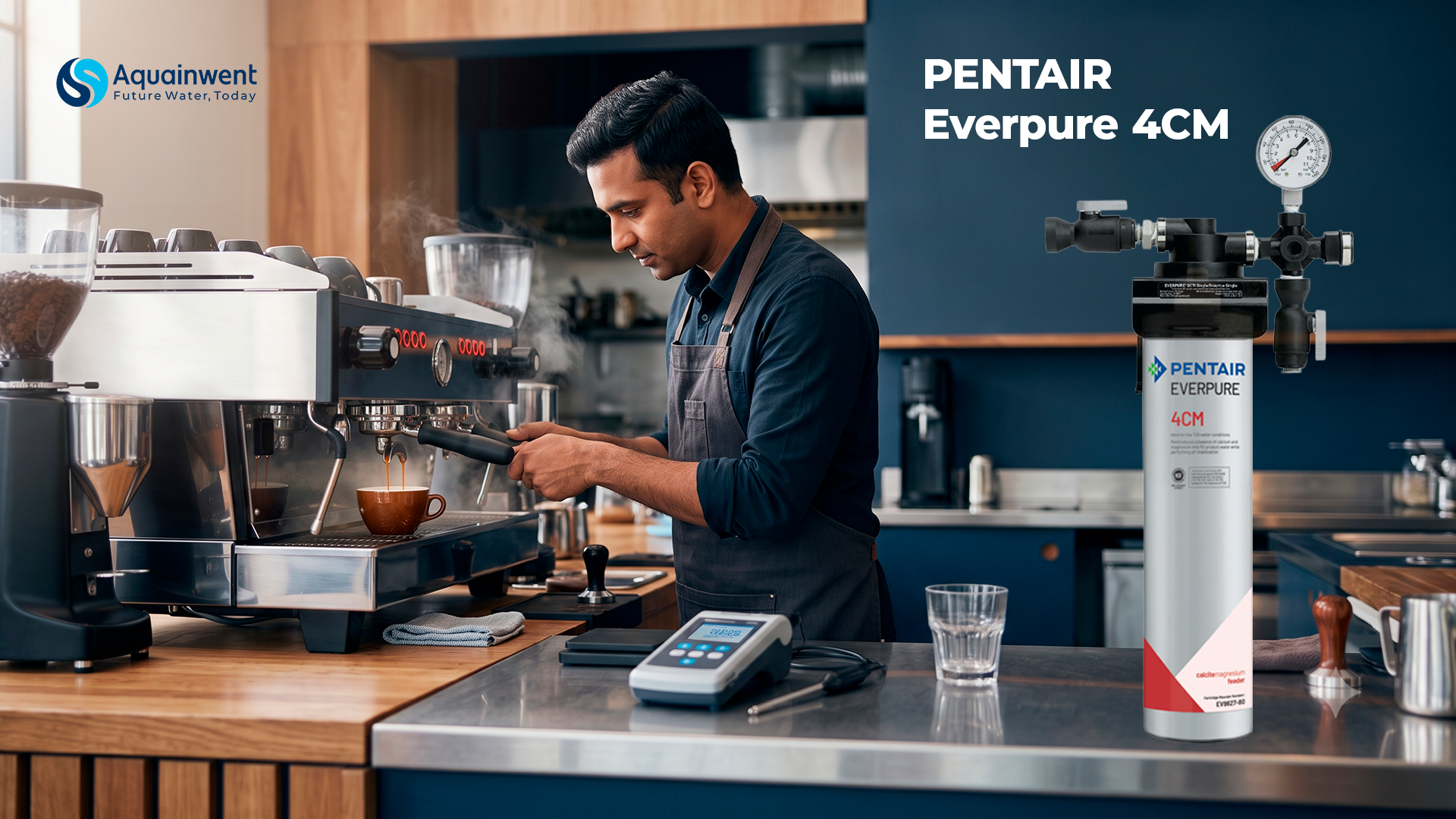
Pentair Everpure 4CM, part number EV9627-80, is a mineral-addition cartridge for use with Everpure EZ-RO 200 and EZ-RO 375 series systems.
It reintroduces a balance of calcium and magnesium into post-RO water, stabilises pH, increases hardness through controlled mineral addition and helps reduce the corrosive tendencies of low-TDS water.
Its rated service flow is 0.5 gpm or 1.9 L/min.
Its capacity is not a fixed number. It varies with feed-water mineral content, flow rate and contact time.
The operational implication: compatibility, demand and site conditions must be checked before specification.
Mineral addition should not be mistaken for filtration
The 4CM should not be positioned as a standalone cartridge for scale inhibition, chlorine taste-and-odour reduction, cyst reduction or 0.2-micron filtration.
Certification also needs its full context: NSF/ANSI 58 and CSA B483.1 apply within EZ-RO 200 and EZ-RO 375 models for TDS reduction—not as independent certification of the cartridge’s mineral-addition function.
For café owners, coffee chains, equipment suppliers and consultants, the correct sequence is:
- Assess the feed water.
- Confirm why RO is required.
- Measure the post-RO condition.
- Check equipment and application requirements.
- Verify flow, pressure and temperature.
Then decide whether controlled mineral addition belongs in the treatment train.
Request a Coffee Water Assessment
📞+91 9920010035