
Water outside the required range
RO may be relevant when tested dissolved constituents fall outside an equipment, beverage or operator specification.
Aquainwent helps commercial operators select appropriately sized RO treatment based on source-water chemistry, daily demand, peak usage and downstream application requirements.
RO reduces dissolved solids and creates a more controlled treated-water starting point for appropriate commercial applications. Final design still depends on the complete treatment and delivery train.

Commercial RO may be appropriate where dissolved-solids levels or water chemistry fall outside the requirements of downstream equipment, beverage programmes or operators. A high TDS reading alone does not determine the treatment.
Source-water chemistry, operating demand, end use and the required final-water profile must be reviewed together before choosing RO, pretreatment or post-treatment.
RO may be relevant when tested dissolved constituents fall outside an equipment, beverage or operator specification.
An RO membrane can reduce a broader dissolved-ion load than conventional particulate or carbon filtration.
Seasonal or source changes may require a more controlled starting point, but target water still depends on the application.
One plant may serve several endpoints, each with its own demand, delivery pressure and downstream-conditioning needs.
Municipal, borewell, tanker, blended or already treated water—and how the source changes through the year.
Useful indicators of dissolved-solids concentration, but not a list of the individual substances present.
Separate chemistry parameters relevant to scale potential, membrane protection and downstream equipment limits.
Review where relevant against the specific application or equipment manufacturer’s permitted water range.
Assess where source conditions indicate fouling or pretreatment risk. No universal feed limit is assumed here.
Evaluate separately. RO alone is not presented as a universal disinfection or microbiological-control solution.
Coffee, ice, steam, beverage and drinking-water uses can require different treated-water profiles and additional steps.
Total treated-water volume required across the operating day and the time available for RO production.
Simultaneous demand, required delivery pressure and the number and location of water points.
Feed supply, power, reject-water drainage, service clearance, storage, boosting and downstream distribution.
Incoming water is pressurised through an RO membrane. The process separates part of the feed into lower-dissolved-solids permeate and a concentrate or reject stream.
Tested incoming water enters the designed treatment train, including pretreatment where the feed conditions require it.
Applied pressure moves water across the RO membrane while many dissolved constituents are rejected to a separate stream.
The lower-dissolved-solids treated-water stream proceeds to storage, distribution or application-specific post-treatment as designed.
The stream carrying a higher concentration of rejected dissolved constituents requires an appropriate discharge and drain plan.
RO does not remove every substance, produce only pure H₂O or create one universal final-water profile. Reject-water handling is a site-design decision; the stream is not automatically classified as reusable or unusable.
TDS measures total dissolved-solids concentration; it does not identify every constituent or determine the complete treatment train.
Useful for tracking overall dissolved-solids concentration before and after RO, without defining the individual ions present.
Depends on particular dissolved constituents and water chemistry—not on TDS alone. Lower TDS is not automatically scale-free.
OEM requirements may address hardness, alkalinity, chloride, silica or other parameters in addition to TDS.
Iron, manganese, turbidity, hardness and other source conditions may affect the pretreatment and membrane-protection strategy.
Coffee, ice, steam, beverage and drinking-water applications may not share the same preferred mineral profile.
Source, storage, distribution and end use determine whether a separate microbiological treatment or disinfection step is appropriate.
A correct commercial design relates how quickly the RO produces water to how much the site uses, when it uses it and how the treated water reaches each endpoint.
For example, Pentair rates MDRO-800 at 2 L/min, equivalent to 120 litres per hour under the stated specification.
Operating hours and the total treated-water requirement help show whether the system can replenish the required volume.
Busy-period demand can be much higher than average use when several endpoints call for water at the same time.
Storage or boosting may be used where required to bridge production and delivery demand. Neither is assumed for every site.
An equivalent production rate of 120 LPH does not mean 120 litres can be supplied instantly at every downstream point.
Aquainwent currently offers two Pentair MDRO configurations in India: MDRO-800 at 120 LPH and MDRO-1600 at 240 LPH. Final selection depends on source-water conditions, treated-water demand and the complete site design.
An engineered RO option rated at 2 L/min. Suitability depends on tested feed water, operating demand, pretreatment and the delivery design.
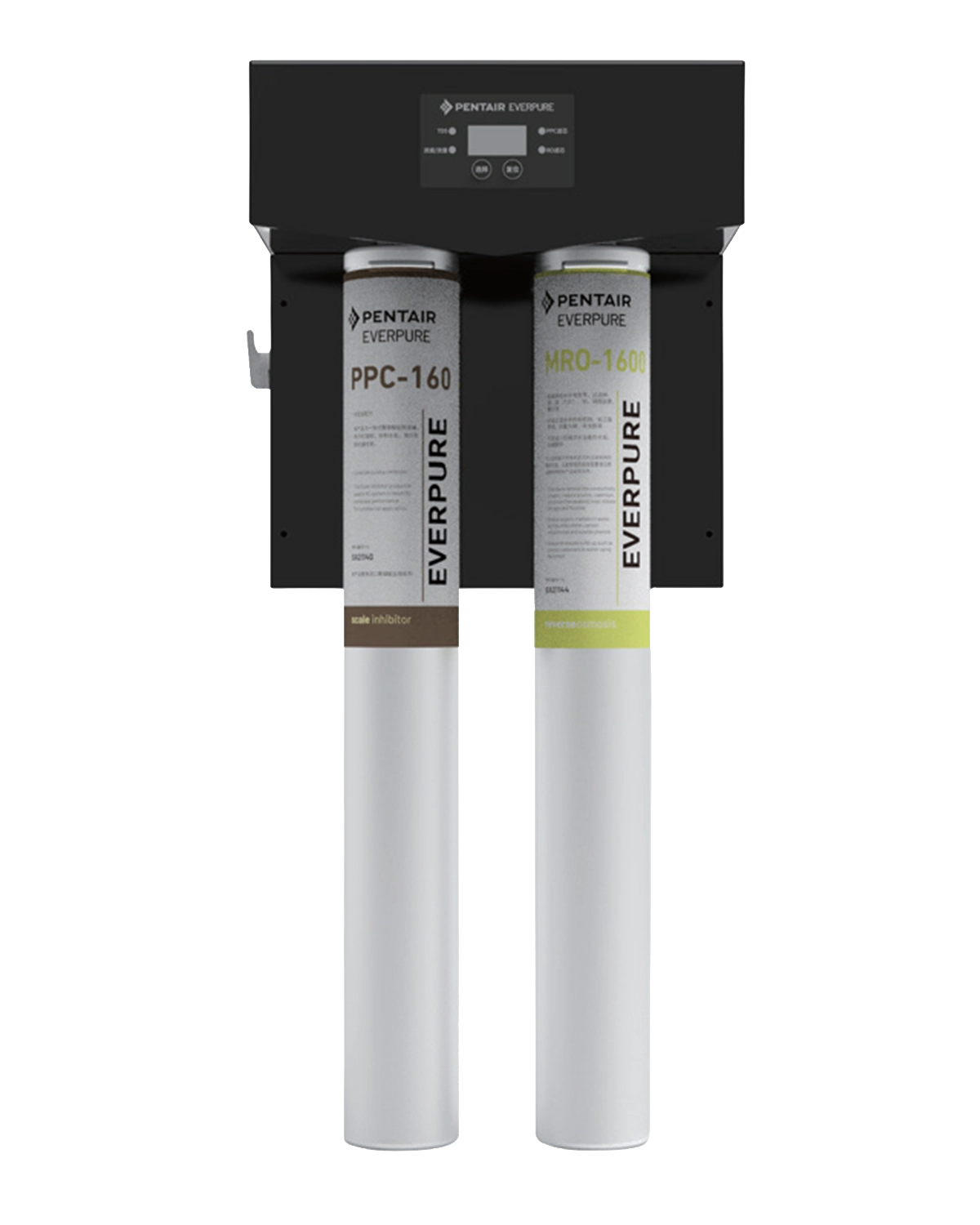
An engineered RO option rated at 4 L/min. Higher rated production does not by itself establish peak-delivery performance or site fit.
Pentair’s listed replacement cycles are guidance, not site-specific life promises: 12–24 months for the PPC phosphate filter cartridges and 12–18 months for the MRO cartridges. Actual timing depends on feed water, pretreatment, demand, operating conditions, monitoring and current service guidance.
Every value below comes from Pentair’s current 2024 MDRO Series specification sheet. LPH equivalents are exact arithmetic conversions of the published L/min values.
| Specification | MDRO-800 | MDRO-1600 |
|---|---|---|
| Rated purification flow | 2 L/min · 120 LPH equivalent | 4 L/min · 240 LPH equivalent |
| Rated total purified-water volume | 9 m³ | 12 m³ |
| Dimensions, W × D × H | 320 × 268 × 598 mm | 320 × 268 × 708 mm |
| Phosphate filter cartridge | PPC-80 | PPC-160 |
| Recommended PPC cycle | 12–24 months | 12–24 months |
| Reverse-osmosis cartridge | MRO-800 | MRO-1600 |
| Recommended MRO cycle | 12–18 months | 12–18 months |
| Inlet / outlet | 3/8 inch | 3/8 inch |
| Recommended inlet pressure | 0.1–0.4 MPa | 0.1–0.4 MPa |
| Operating pressure | 0.6–0.9 MPa | 0.6–0.9 MPa |
| Inlet-water temperature | 5–38°C | 5–38°C |
| Rated power | 108 W | 216 W |
| Water-efficiency rating | Level 1 | Level 1 |
The 9 m³ and 12 m³ figures are Pentair’s “rated total volume of purified water.” They are not daily-production figures, storage-tank capacities or guaranteed cartridge life. Final selection requires an application assessment.
Pentair documents these features for the MDRO Series. They support operation and maintenance planning but do not replace engineered installation, commissioning or service procedures.
The interface displays a TDS value for operational information; no unstated accuracy or treated-water target is promised.
Flow rate and flow-speed information are shown for water-management visibility.
Supports cartridge-stock and replacement planning alongside water, duty and condition checks.
Provides fault information to support troubleshooting and technical follow-up.
Provided for emergency water continuity. Bypass water must not be assumed to remain RO-treated.
A documented cartridge-interface feature; authorised service roles and procedures must follow the installed system guidance.
Pentair describes a reserved IoT function interface. Integrated remote management is not presented as standard.
The documented one-piece moulded aluminium can is part of the MDRO construction.
Pentair describes the family as supporting multiple water points and peak water usage. Actual endpoint count, simultaneous draw, storage, delivery pressure and distribution still require site-specific design.
MDRO is engineered commercial RO equipment. It must not be treated like a simple point-of-use cartridge system or assumed suitable for untreated municipal, borewell or tanker water without assessment.
Test relevant feed-water parameters before model and treatment-train selection. TDS alone is not sufficient.
Use Pentair’s exact term: phosphate filter cartridge—PPC-80 for MDRO-800 and PPC-160 for MDRO-1600.
External softening, iron treatment or other steps may be required when tested feed conditions and membrane protection call for them.
Confirm the applicable electrical supply, feed pressure, 3/8-inch connections, isolation and project plumbing requirements.
Provide an appropriate discharge route and drainage plan. No fixed reject ratio or recovery percentage is assumed.
Review storage, downstream boosting, delivery pressure, plumbing, service access and commissioning where the application requires them.
No standard accessory assumption: a storage tank, booster pump, UV stage or remineralisation assembly is not presented as integrated or supplied as standard. The complete system scope must be confirmed for the project.
RO is a treatment platform, not one universal final-water profile. Each endpoint may require different conditioning, storage, pressure or microbiological controls.
RO may suit source water requiring broader dissolved-solids reduction. Post-RO mineral conditioning may be appropriate for the desired beverage-water profile.
RO can reduce dissolved-mineral load, but final ice clarity also depends on machine design, freezing process, trapped air and operating conditions.
RO may be appropriate when source water falls outside the exact equipment manufacturer’s permitted water-quality range.
Final water should follow the beverage-system, operator and equipment requirements; one permeate profile is not assumed for every programme.
Source conditions, storage, distribution and microbiological requirements determine whether additional filtration or disinfection is appropriate.
Separate branches may require blending, mineral conditioning, polishing, storage or pressure design matched to each end use.
A complete project may combine technologies, but every stage must have a defined role supported by water analysis and the downstream requirement.
Performance depends on the selected, documented media and configuration.
Ion exchange reduces calcium and magnesium hardness through a different mechanism.
A membrane process that produces lower-dissolved-solids permeate and a concentrate stream.
A separate treatment consideration where microbiological control is required.
Application-specific blending, remineralisation, polishing, storage or boosting may be part of the downstream design. None is claimed as a built-in MDRO module or universal requirement.
Aquainwent helps customers select and buy products. A website enquiry does not book a site visit or installation.
Tell us the application, location and any product or equipment details you know.
Our team reviews the requirement against product specifications and any available water readings.
The team can discuss direct supply or connect you with an appropriate dealer and confirm the quotation.
Confirm product availability, delivery and any separately agreed installation or service responsibilities.
Trusted by leading hospitality & foodservice brands

















Starbucks · McDonald’s · Marriott · Taj · Hilton · Oberoi · Fairmont · Westin · Barclays · KKR — and 100+ premium establishments across India.
Representative brands and hospitality groups where Everpure® by Pentair solutions supplied through Aquainwent or its dealers have been deployed. Brand names and trademarks are the property of their respective owners and are used for identification only. Logo presence does not imply endorsement or use of a specific MDRO model or configuration.
Aquainwent LLP is listed in Pentair Asia’s official Distributor/Dealer directory for India under Commercial Filtration & Foodservice.
Evidence-disciplined answers for operators, engineering teams, consultants, procurement teams and equipment partners.
A commercial reverse-osmosis system pressurises feed water through a membrane, producing a lower-dissolved-solids permeate stream and a concentrate or reject stream. It can create a more controlled treated-water starting point, but the complete treatment, storage and distribution arrangement must match the source water and application.
Yes. Reverse osmosis reduces many dissolved ions and therefore lowers total dissolved solids in the permeate. The resulting TDS depends on feed-water chemistry, membrane condition, operating conditions and system configuration, so no universal treated-water value should be assumed.
No. RO may be appropriate where dissolved-solids levels or water chemistry fall outside downstream equipment, beverage or operator requirements. TDS should be reviewed with hardness, alkalinity, chloride, silica, chlorine, turbidity, other relevant parameters and the required end use.
A softener uses ion exchange to reduce calcium and magnesium hardness. RO uses a membrane to reduce a broader range of dissolved solids in the treated-water stream. A softener does not reduce overall TDS in the same way as RO, and some RO feed-water conditions may still require pretreatment.
RO can reduce dissolved calcium and magnesium in the permeate, but it is not the same process as ion-exchange softening. Feed-water hardness, membrane protection and any pretreatment requirement still need to be assessed.
No treatment should be described as making every application scale-free. Scale potential depends on specific dissolved constituents and water chemistry. RO can reduce scale-forming dissolved-mineral load where applicable, which may reduce downstream scale potential.
Pentair publishes a rated purification flow of 2 L/min for MDRO-800 and 4 L/min for MDRO-1600—equivalent to 120 and 240 LPH respectively. These figures describe treated-water production over time; they are not guarantees of instantaneous delivery at every downstream outlet. Final selection also depends on source-water conditions, daily demand, peak draw, operating hours and the complete storage/distribution design where applicable.
Not every installation uses the same storage arrangement. Storage may be used to buffer steady RO production against peak draw. The need, type and size depend on production rate, operating hours, simultaneous demand, available space, hygiene controls and downstream pressure requirements.
The MDRO family is described for multiple-water-point and peak-use applications, but actual performance depends on the number of endpoints, simultaneous demand, storage strategy, delivery pressure, downstream plumbing and distribution design.
Not in every case. Where RO produces water below the desired mineral profile for a coffee programme, post-RO mineral conditioning may be appropriate. The target should follow the coffee equipment, beverage recipe and operator requirements.
It may, where the tested source water and ice-machine requirements support that approach. RO can reduce dissolved-mineral load, but final ice clarity also depends on machine design, freezing process, trapped air and operating conditions.
It may be appropriate where source water falls outside the equipment manufacturer’s permitted water-quality range. The final treatment must follow the exact OEM limits, including any requirements for hardness, alkalinity, chloride, silica or other parameters.
Pentair’s MDRO specification lists recommended cycles of 12–24 months for PPC cartridges and 12–18 months for RO cartridges. These are guidance rather than a site-specific guarantee; actual timing depends on feed water, pretreatment, demand, operating conditions, monitoring and the applicable service guidance.
RO should not be presented as a universal microbiological barrier under every configuration. Source-water condition, storage, distribution and the application’s microbiological requirements determine whether additional treatment or disinfection is appropriate.
Ask about a listed product or share your requirement. Our team will review the enquiry and discuss direct supply or an appropriate dealer contact.