
Defined point of use
Treatment is selected around a drinking-water outlet, dispenser or assessed group of endpoints rather than residential purifier assumptions.
Aquainwent helps commercial facilities select drinking-water treatment around the source water, taste and odour concerns, particulate, dissolved-solids requirements, microbiological considerations, required flow and number of outlets.
For hotels, restaurants, cafés, QSRs, offices, institutions, staff pantries and multi-site commercial operations.
Commercial drinking-water filtration treats water at one or more business-use points for a defined source-water condition and required output. Depending on the issue, treatment may range from compact point-of-use filtration to a broader treatment train involving prefiltration, reverse osmosis, ultraviolet treatment or water softening.
No single filter is correct for every commercial site. Suitable feed-water quality must be established before treatment selection.
Treatment is selected around a drinking-water outlet, dispenser or assessed group of endpoints rather than residential purifier assumptions.
Each product is used only for its documented flow, capacity, operating conditions and exact reduction claims.
Filtration, RO, UV and softening address different water conditions and should not be presented as interchangeable.
The visible complaint may be only one part of the decision. Source, chemistry, microbiological context and actual demand must be reviewed together.
Product-specific carbon filtration can reduce chlorine taste and odour and support a more consistent drinking-water experience.
Suspended material can affect clarity, flow and cartridge loading. Higher sediment loads may require separately assessed prefiltration.
Only reduction claims documented for the exact product and configuration should guide selection.
Standard point-of-use filtration is not an RO process. Broader dissolved-solids reduction requires separate assessment.
Calcium and magnesium hardness is addressed by softening. Softening does not reduce TDS like RO and does not disinfect water.
Standard POU filtration is not general disinfection. An additional treatment barrier may be required after source, storage and distribution review.
Endpoint count alone is insufficient; peak flow, simultaneous demand, daily consumption and distribution must be checked.
Identify municipal, borewell, tanker, building-storage or blended supply and expected variability.
Review current laboratory or site data when available rather than inferring quality from source type.
Use dissolved-solids information as one input—not a complete measure of drinking-water quality.
Measure calcium and magnesium hardness where scale, mineral content or softening may be relevant.
Check the applicable disinfectant condition when taste, odour or carbon-filtration duty is a concern.
Understand suspended material that may affect clarity, cartridge loading or the need for prefiltration.
Match any reduction requirement to exact current product evidence; do not infer a blanket capability.
Review source, storage and distribution risk where an additional treatment barrier may be required.
Record dispensers, faucets and other endpoints together with the intended distribution arrangement.
Confirm simultaneous demand so the selected configuration is not hydraulically undersized.
Estimate total consumption to guide capacity and cartridge-replacement planning.
Document filtration, RO, UV, softening or other stages already installed.
Confirm plumbing, pressure, available space, isolation, service clearance and any distribution constraints.
Each technology has a defined role. The appropriate route follows the actual source-water condition and required drinking-water outcome.
For established feed water where the verified concern involves chlorine taste and odour, particulate or an exact certified reduction claim.
Where broader reduction of dissolved ions or solids is required after source-water assessment.
Where source, storage or distribution conditions indicate that a microbiological-treatment barrier is appropriate.
Where calcium and magnesium hardness is the principal issue.
Final treatment should be selected from the actual source-water condition and the required drinking-water outcome. RO and UV are not universal requirements, and softened-water suitability depends on the intended use and water-quality requirements.
This comparison describes general technology roles. Exact capability still depends on the selected product and configuration.
| Technology | Main role | Reduces hardness? | Reduces TDS? | Microbiological treatment? | Typical drinking-water role |
|---|---|---|---|---|---|
| POU filtration | Product-specific reduction of chlorine taste and odour, particulate and certified contaminants | No | No—standard POU filtration is not a TDS-reduction technology | Not general disinfection; certified mechanical cyst reduction only where applicable | Established feed water at a defined drinking-water point |
| Reverse osmosis | Broader reduction of dissolved ions and solids | May reduce hardness-forming ions; it is not a softener | Yes | Not presented here as the site’s disinfection barrier or a potability guarantee | Where chemistry and intended output require dissolved-solids reduction |
| UV | Additional microbiological-treatment barrier when correctly selected and operated | No | No | Yes, for the applicable validated treatment duty | Where source, storage or distribution creates an assessed microbiological requirement |
| Water softening | Ion exchange to reduce calcium and magnesium hardness | Yes | No | No | Hardness control; suitability depends on intended use and water-quality requirements |
Where suitable feed-water quality has been established and the main concerns fall within the selected product’s verified capabilities, POU filtration may be the appropriate route. This is not a potability guarantee and does not replace source-water testing or required microbiological control.
Use the filter for exact documented duties such as chlorine taste and odour, particulate or certified cyst reduction where applicable.
Confirm the required service flow, total consumption, pressure and outlet arrangement before selecting the configuration.
Not necessarily. 4FC is not an RO system. Where broader dissolved-solids reduction is required, commercial RO should be assessed separately.
Manufacturer safety principle: Do not use the system with water that is microbiologically unsafe or of unknown quality without adequate disinfection before or after the system, where required by the applicable product instructions. Systems certified for cyst reduction may be used with disinfected water that may contain filterable cysts.
These are different point-of-use formats. Their claims, certification evidence and operating conditions remain product and configuration specific.
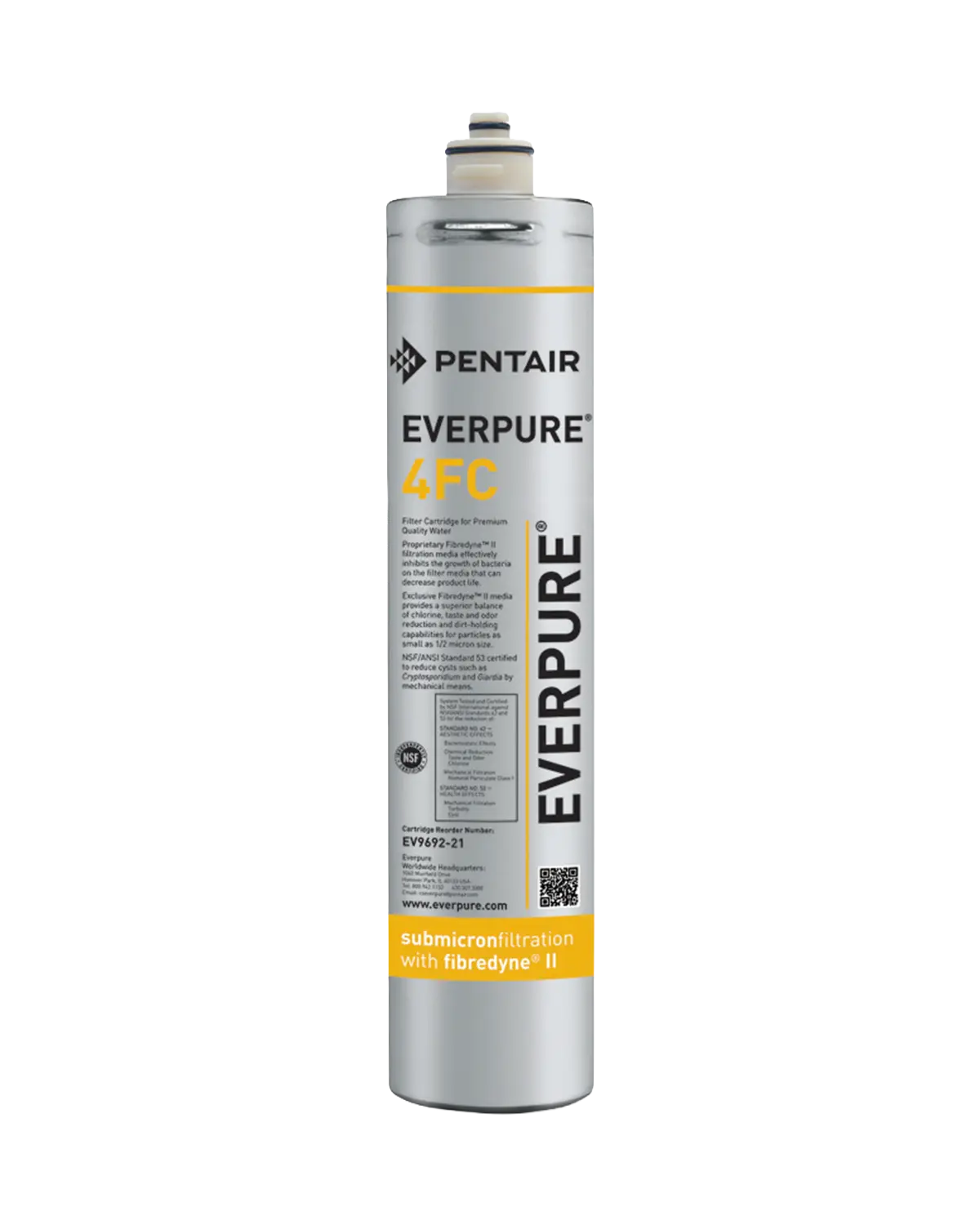
A high-capacity POU cartridge for commercial drinking-water and beverage-dispensing applications where its verified chlorine, particulate and cyst-reduction performance is appropriate to the source water and installed configuration.
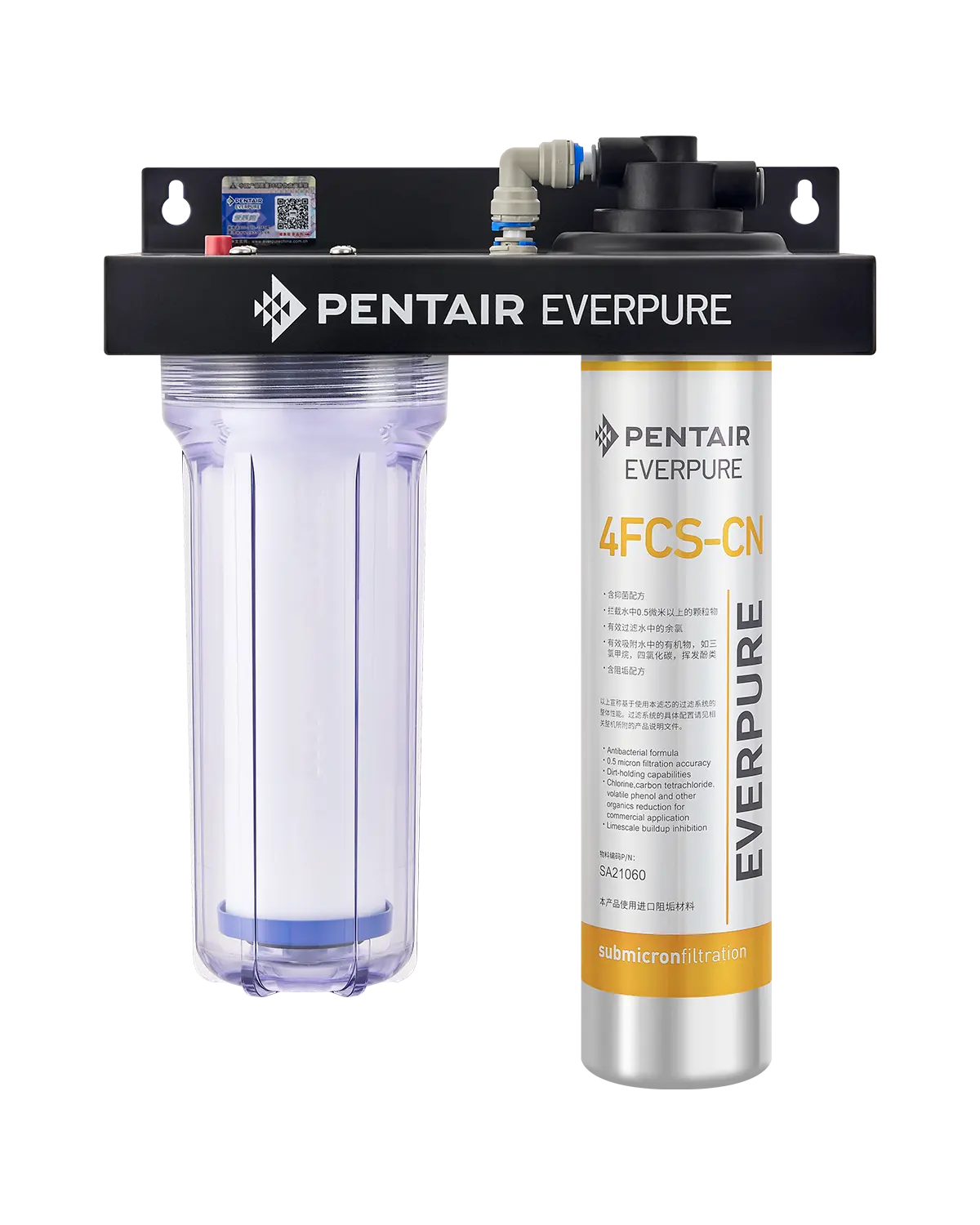
An integrated compact POU drinking-water configuration for a dedicated commercial outlet where its published flow, capacity, feed-water and installation conditions match the site.
The 4FC image shows the EV9692-21 cartridge, not a complete installed system; the compatible head or system configuration must be confirmed. The 4FC is not an RO or UV system. Combo-4FCS-CN does not inherit 4FC’s NSF/ANSI claims. Combo purification and residual-chlorine flow/capacity ratings are separate published values and must not be collapsed into one rating. Final suitability depends on current product instructions, source water and the installed configuration.
Neither format is universally better. Compare the installed architecture, source-water requirement, demand and available space.
| Decision point | Everpure 4FC | Combo-4FCS-CN |
|---|---|---|
| Format | Replaceable cartridge used with a compatible Everpure head or system configuration | Integrated POU system with prefilter, documented main cartridge and faucet arrangement |
| Identifier | EV9692-21 | System SA31216; main cartridge SA21060 |
| Filtration | 0.2 µm | 0.5 µm filtration precision |
| Published flow | Maximum 2.5 gpm / 9.5 LPM | 4 L/min purification; 7.57 L/min residual-chlorine treatment |
| Published capacity | 15,000 gal / 56,781 L | 10,000 L total purification; 56,781 L residual-chlorine treatment |
| Connection / architecture | Compatible Everpure head or manifold must be confirmed | 3/8 inch integrated installation; included-component arrangement per current sheet |
| Certification handling | NSF/ANSI 42 and 53 for the exact claims listed in the 4FC specification | No NSF badge or inherited 4FC certification claim on this page |
| Selection emphasis | Demand, compatible head, pressure, service clearance and exact reduction duty | Dedicated-point requirement, feed suitability, pressure, space and documented system conditions |
Product comparison supports screening only. Aquainwent should confirm the current component set and site fit before supply; installation arrangements are agreed separately.
Possibly, but endpoint count alone does not establish fit. One cartridge should not be assumed to supply an entire building.
Review the highest combined demand, not only average use or the number of installed outlets.
Estimate total drinking-water demand to plan cartridge capacity and replacement.
Account for inlet pressure, distribution length and the effect of multiple endpoints.
Confirm the correct head, manifold or dedicated integrated system for the installed layout.
These general statements apply to verified commercial point-of-use filtration configurations, subject to site conditions and the exact Pentair instructions.
Designed for straightforward installation by a qualified plumber.
Quick-change cartridges can generally be replaced by trained site staff without specialist tools.
Compact point-of-use format designed for installation close to the connected drinking-water outlet or equipment.
Confirm compatible plumbing, pressure, isolation and service clearance. Follow the applicable installation procedure, isolate before replacement, flush as instructed, perform a leak check and use the approved genuine replacement cartridge.
These examples identify what to assess; they do not guarantee that one product is suitable for every location in the category.
Review guest points, staff areas, storage, simultaneous demand and engineering access.
Separate guest drinking-water requirements from beverage, kitchen and equipment-water duties.
Assess drinking-water points alongside the distinct water requirements of coffee and beverage equipment.
Confirm high-traffic demand, outlet arrangement, cartridge responsibility and repeatable site procedures.
Review occupancy, peak break periods, floor-by-floor distribution and existing dispensers.
Confirm each pantry’s source, point count, space, pressure and replacement access.
Document population, source-water controls, storage, distribution and operating responsibility.
Keep direct drinking-water requirements distinct from warewashing, combi oven and other equipment feeds.
Test each source and define a documented selection and replacement standard with site-specific exceptions.
Aquainwent helps customers select and buy products. A website enquiry does not book a site visit or installation.
Tell us the application, location and any product or equipment details you know.
Our team reviews the requirement against product specifications and any available water readings.
The team can discuss direct supply or connect you with an appropriate dealer and confirm the quotation.
Confirm product availability, delivery and any separately agreed installation or service responsibilities.
Trusted by leading hospitality & foodservice brands


Starbucks · McDonald’s · Marriott · Taj · Hilton · Oberoi · Fairmont · Westin · Barclays · KKR — and 100+ premium establishments across India.
Representative brands and hospitality groups where Everpure® by Pentair solutions supplied through Aquainwent or its dealers have been deployed. Brand names and trademarks are the property of their respective owners and are used for identification only. Logo presence does not imply endorsement or use of a specific drinking-water product or configuration.
Aquainwent LLP is listed in Pentair Asia’s official Distributor/Dealer directory for India under Commercial Filtration & Foodservice.
Concise, product-specific answers for operators, facility teams, consultants, procurement teams and project partners.
A commercial drinking-water filter treats water at a defined business-use point for verified concerns such as chlorine taste and odour, particulate or specific certified contaminants. The correct system depends on the source water, required flow, daily demand and intended output.
Reduction performance is product-specific. For example, the Everpure 4FC is documented for chlorine taste and odour reduction, fine particulate filtration and certified mechanical cyst reduction. One cartridge’s claims must not be applied to every Everpure product.
Not necessarily. Standard Everpure point-of-use filters such as 4FC are not reverse-osmosis systems and should not be presented as TDS-reduction systems. Where broader dissolved-solids reduction is required, commercial RO should be assessed separately.
Point-of-use filtration targets specific physical, aesthetic or certified contaminant-reduction duties. Reverse osmosis reduces a broader range of dissolved ions and solids. The correct route depends on source-water chemistry and the required drinking-water outcome.
Standard point-of-use filtration is not general disinfection. An appropriately selected UV system may provide an additional microbiological-treatment barrier where the source, storage or distribution conditions indicate that it is required.
Standard carbon or precoat filtration should not be described as killing bacteria, removing viruses or sterilising water. Where microbiological treatment is required, an appropriate additional barrier must be assessed.
Certified cyst reduction means an exact filter has been tested for mechanical reduction of specified cysts under the applicable standard. It is not a blanket claim for bacteria removal, virus removal, sterilisation or complete drinking-water safety.
NSF/ANSI 42 covers specified aesthetic effects such as chlorine taste and odour or particulate claims; NSF/ANSI 53 covers specified health-effect reduction claims. Certification is product-, configuration- and claim-specific and is not a blanket potability or FSSAI claim.
The 4FC is a high-capacity point-of-use cartridge for appropriate commercial drinking-water and beverage-dispensing applications that require its documented flow, capacity and reduction performance.
Combo-4FCS-CN is an integrated compact point-of-use drinking-water configuration for a dedicated commercial outlet where its published feed-water, flow, capacity, pressure and installation conditions match the site.
Follow the exact cartridge instructions. Replacement may depend on rated capacity, an applicable service interval, source-water quality, actual usage and flow or pressure condition. There is no universal six-month rule for every Everpure cartridge.
Quick-change cartridges can generally be replaced by trained site staff without specialist tools. The applicable isolation, replacement, flushing and leak-check procedure must still be followed.
The system is designed for straightforward installation by a qualified plumber using the applicable Pentair instructions. Plumbing, pressure, isolation, service clearance, flushing and leak checking must be confirmed.
It may be possible when the exact system or manifold is sized for combined peak flow, daily demand, pressure and distribution. One cartridge should not be assumed to serve an entire building without assessment.
Ask about a listed product or share your requirement. Our team will review the enquiry and discuss direct supply or an appropriate dealer contact.