
Taste and odour
Chlorine taste and odour in feed water can carry into served ice and the beverages it cools.
Aquainwent helps commercial operators select Everpure by Pentair filtration for the actual ice machine, water condition and operating demand—reducing sediment and chlorine taste and odour while helping manage mineral scale.
For hotels, restaurants, cafés, QSRs, bars, cloud kitchens, institutions and multi-site operators across India.

Feed water becomes part of the served ice and also passes through the machine. Sediment, chlorine, mineral content and source variability can therefore affect taste, appearance and water-related deposits inside the equipment.
The right ice-machine filter is not a universal cartridge. It is a configuration selected around the exact machine, source water, peak demand, pressure, plumbing and service plan.
Chlorine taste and odour in feed water can carry into served ice and the beverages it cools.
Sediment and fine suspended material can affect water appearance, passages and cartridge loading.
Hardness minerals can form scale under relevant conditions and add a water-related cleaning and maintenance burden.
Particulate is one variable, while dissolved solids, trapped air and the machine’s freeze process also influence clarity.
Municipal, borewell, tanker and blended supplies can vary between locations and over time.
Service flow, production demand and machine count influence configuration and cartridge-capacity planning.
A visible symptom is not a complete diagnosis. Equipment data and site-water context help connect the concern to the appropriate treatment role.
Disinfectant taste or odour may be present in the incoming water.
It can carry into ice and the drink it cools.
Water source, disinfectant condition, peak flow and verified reduction performance.
Visible or fine suspended material may enter the ice machine.
Particulate can affect appearance, narrow passages and filter loading.
Source, sediment load, plumbing condition and whether a prefilter is relevant.
Hardness minerals can form deposits inside relevant water-contact areas.
Deposits can add cleaning needs and interfere with water-contact surfaces.
Hardness, alkalinity, temperature, machine guidance and operating conditions.
Municipal, tanker, borewell or blended supplies can change by site or season.
One configuration may not address the same conditions at every location.
Each source, existing treatment, variability and a location-specific plan.
Cloudiness or visible particulate may be noticed in finished ice.
Appearance matters in beverage and hospitality presentation.
Particulate, TDS, trapped air, freeze process, machine condition and sanitation.
The installed system may not match machine demand or the water condition.
Insufficient flow or capacity can undermine the intended treatment plan.
Exact model, rated production, peak demand, machine count, pressure and space.
Record the make, model and whether it is a cuber, flaker or another machine type requiring confirmation.
Review rated ice production, peak water demand, operating hours and the number of machines served.
Identify municipal, borewell, tanker, blended or already treated water, including expected seasonal variation.
Check the taste-and-odour concern, suspended material, plumbing condition and likely cartridge loading.
Review mineral loading and dissolved solids separately; scale inhibition does not remove hardness or reduce TDS.
Confirm available pressure and peak flow against both the machine and the selected filtration configuration.
Check inlet and outlet requirements, isolation, pipework, mounting orientation and any applicable drain or utility needs.
Allow suitable mounting space, cartridge-change clearance and access for inspection, flushing and leak checks.
Plan cartridge capacity, monitoring, replacement responsibility and prefilter inspection where the configuration includes one.
Each treatment stage has a defined role. Keeping those roles separate prevents scale inhibition from being mistaken for softening or dissolved-solids reduction.
Micro-Pure II media provides fine precoat filtration for particulate reduction in the displayed configurations.
The displayed configurations have exact NSF/ANSI 42 scope for chlorine, taste-and-odour and nominal particulate Class I reduction.
The displayed configurations have exact NSF/ANSI 53 scope for cyst reduction by mechanical means.
A self-contained scale-inhibitor feed helps inhibit mineral-scale formation inside relevant machine components.
Some hardness, TDS, sediment or source-water conditions can require a different or additional treatment route. Water testing and machine requirements should determine whether prefiltration, softening, reverse osmosis or another engineered approach is relevant.
These current Aquainwent catalogue configurations serve different flow, capacity and prefiltration needs. Final suitability must be confirmed against the exact ice machine, site water and demand.
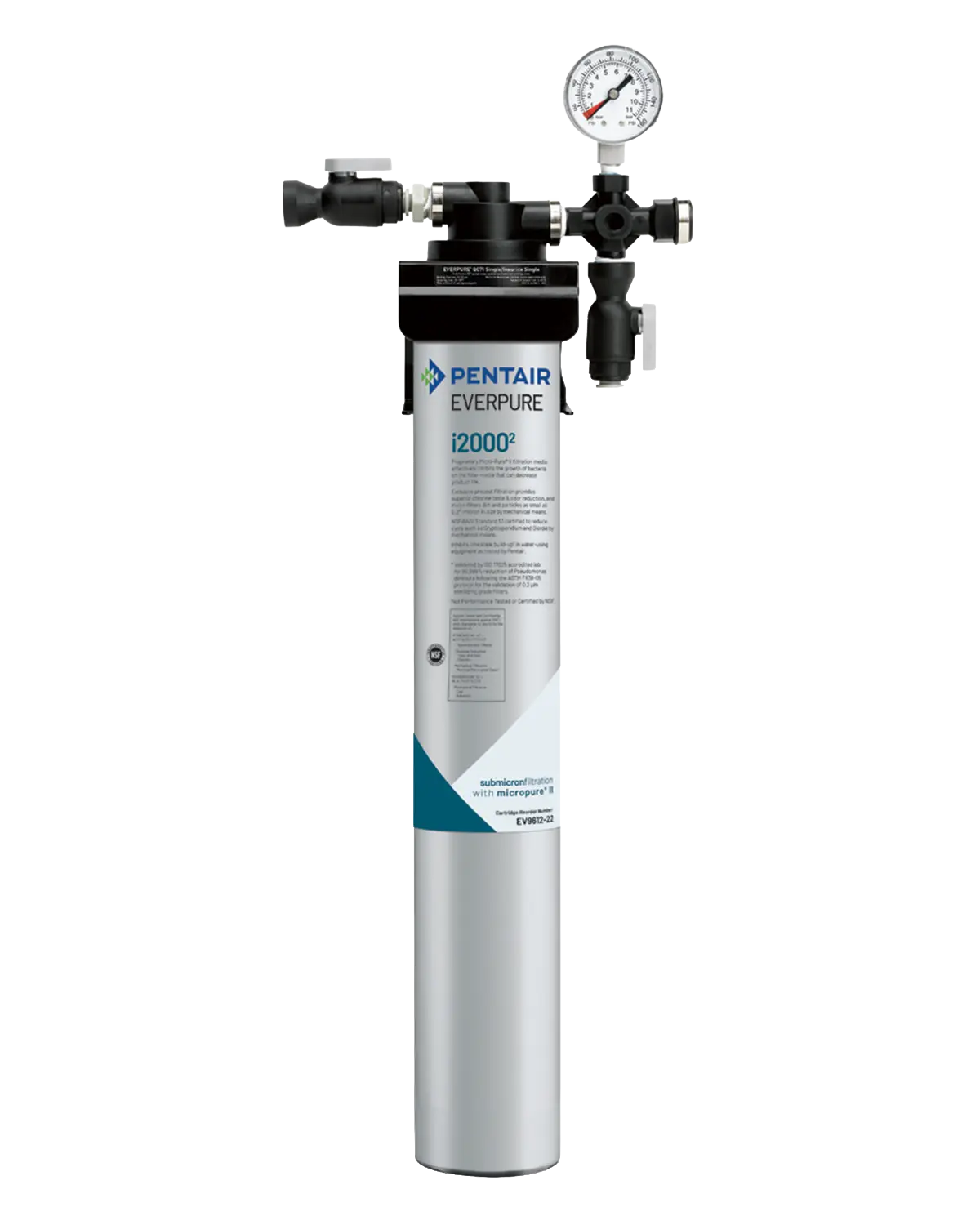
EV9324-01 combines precoat filtration with chlorine taste-and-odour, particulate and cyst reduction, plus a self-contained scale-inhibitor feed. Pentair documents the configuration for applicable cuber and flaker applications; exact machine fit still requires assessment.
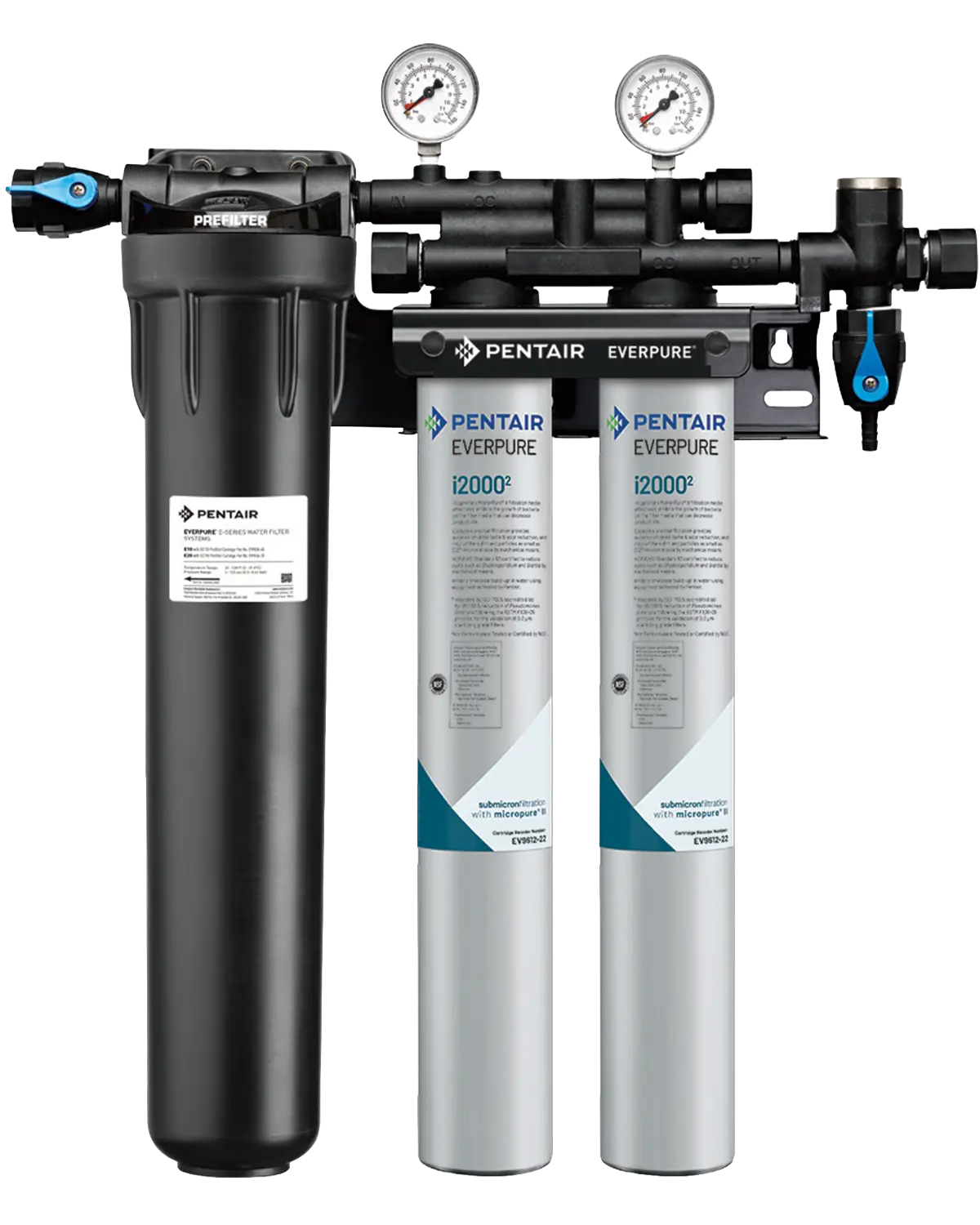
EV9324-22 uses two i2000² cartridges and adds an EC210 prefilter to intercept larger dirt and rust particles. The prefilter has its own inspection and replacement duty; final machine fit and configuration still require assessment.
EV9324-01 and EV9324-22 are certified under NSF/ANSI 42 for chlorine, taste-and-odour and nominal particulate Class I reduction, and under NSF/ANSI 53 for cyst reduction by mechanical means. Exact certification scope remains tied to each listed system; the scale-inhibitor function is not a hardness-removal or TDS-reduction claim.
Match the machine’s peak requirement and any simultaneous demand to the configuration’s verified maximum service flow.
Use expected water consumption and source conditions to plan capacity and replacement—not a generic small-versus-large label.
Review the exact machine model, rated ice production, operating hours and whether one system will serve more than one machine.
Assess chlorine, sediment, hardness, TDS and variability. Twin PF adds a coarse-sediment prefilter; it is not automatically the right choice for every site.
Confirm available pressure, connection sizes, pipework and the machine manufacturer’s utility requirements.
Allow mounting and service clearance for every cartridge, including separate EC210 prefilter inspection on Twin PF.
Final sizing should be confirmed against the actual ice-machine model and site water conditions.
For the displayed point-of-use ice filtration configurations, compact quick-change formats support practical installation and a documented cartridge-management plan.
Designed for straightforward installation by a qualified plumber.
Quick-change cartridges can generally be replaced by trained site staff without specialist tools.
Compact point-of-use format designed for installation close to the connected ice equipment.
Follow the applicable isolation, cartridge-change, five-minute full-flow flushing and leak-check procedure. Replacement depends on water quality, water demand, rated capacity and the applicable flow or pressure condition; use the current guidance supplied for the exact installed configuration.
These point-of-use statements do not establish the sizing, utility, installation or commissioning requirements for standalone softening, reverse osmosis or other engineered treatment routes.
The assessment emphasis changes with machine type, operating model, peak demand, source water and the number of locations.
Review banquet, restaurant, bar and back-of-house demand, machine count, engineering access and replacement ownership.
Match the machine and busy-service demand while separating ice filtration from other kitchen-water applications.
Assess ice and coffee equipment as distinct applications with their own water, flow and cartridge requirements.
Prioritise peak demand, repeatable cartridge procedures, practical service access and location-specific water conditions.
Consider beverage presentation, chlorine taste and odour, ice-machine demand and limited back-bar installation space.
Confirm production demand, source variability, utility layout and maintenance responsibility within a compact operating site.
Document equipment schedules, water conditions, operating peaks and lifecycle responsibilities across service areas.
Assess each source, then standardise decision criteria and cartridge records without assuming identical treatment everywhere.
Aquainwent helps customers select and buy products. A website enquiry does not book a site visit or installation.
Tell us the application, location and any product or equipment details you know.
Our team reviews the requirement against product specifications and any available water readings.
The team can discuss direct supply or connect you with an appropriate dealer and confirm the quotation.
Confirm product availability, delivery and any separately agreed installation or service responsibilities.
Trusted by leading hospitality & foodservice brands


Trusted by 100+ premium establishments across India.
Representative brands and hospitality groups where Everpure® by Pentair solutions supplied through Aquainwent or its dealers have been deployed. Brand names and trademarks are the property of their respective owners and are used for identification purposes only.
Aquainwent LLP is listed in Pentair Asia’s official Distributor/Dealer directory for India under Commercial Filtration & Foodservice.
Evidence-disciplined answers for commercial operators, project teams and equipment partners.
A correctly specified filter treats feed water before it enters the ice machine. The displayed Insurice i2000² configurations provide fine precoat filtration, chlorine taste-and-odour reduction, certified cyst reduction and a self-contained scale-inhibitor feed.
No. The scale-control stage helps inhibit mineral-scale formation; it does not remove calcium and magnesium hardness like a water softener or reduce dissolved solids like reverse osmosis.
Scale inhibition helps limit mineral deposits by feeding a scale inhibitor into the water. It manages deposit formation without removing calcium and magnesium hardness from the water.
Filtration can help by reducing particulate and certain water-quality variables. Final ice clarity also depends on dissolved solids, trapped air, the machine’s freezing process, machine condition and maintenance.
Where chlorine taste and odour are present, the displayed certified systems can reduce them. Filtration cannot correct every possible taste issue.
The displayed Insurice i2000² systems combine fine precoat filtration with chlorine taste-and-odour reduction, certified cyst reduction and a self-contained scale-inhibitor feed. Exact performance and certification remain configuration-specific.
Selection depends on peak demand, maximum service flow, cartridge capacity, number of machines, source-water conditions, pressure, plumbing and available space—not machine size alone. The current Twin PF configuration also includes an EC210 prefilter.
Pentair documents applicable Insurice configurations for cuber and flaker applications. Final selection must be checked against the exact make, model, rated production, water demand and operating requirements.
Replacement depends on water quality, usage, rated capacity and the applicable flow or pressure condition for the installed configuration. Follow the current cartridge and system guidance supplied for that exact model rather than applying one interval to every configuration.
Quick-change cartridges can generally be replaced by trained site staff without specialist tools. Staff should follow the prescribed isolation, cartridge-change, five-minute full-flow flushing and leak-check procedure for the installed configuration.
Designed for straightforward installation by a qualified plumber. Correct mounting, connections, pressure and flow checks, flushing, leak testing, service clearance and equipment compatibility still need confirmation.
Some hardness, TDS, sediment or source-water conditions can require a different or additional treatment route. Water testing and machine requirements should determine whether prefiltration, softening, reverse osmosis or another engineered approach is relevant.
Ask about a listed product or share your requirement. Our team will review the enquiry and discuss direct supply or an appropriate dealer contact.