
Heating and evaporation
Repeated heating can concentrate mineral deposits on water-contact surfaces and pathways.
Aquainwent helps hotels and commercial kitchens select Everpure by Pentair water treatment for combi ovens and steam equipment using source-water analysis, the exact equipment manufacturer’s requirements, service-flow demand and installation conditions.
Manage particulate, chlorine and limescale risk at the feed-water line with treatment matched to the oven, source water and operating demand.

A combi oven water filter treats feed water before it enters the boiler or steam generator. In an applicable Kleensteam configuration, carbon and particulate filtration is combined with HydroBlend scale inhibition; exact functions depend on the installed components.
Steam-generating equipment can be particularly sensitive to scale because dissolved minerals remain behind as water is converted to steam. Treatment must align with the exact oven manufacturer’s water specification.
Repeated heating can concentrate mineral deposits on water-contact surfaces and pathways.
Hardness, alkalinity, temperature, equipment design and operating demand influence limescale formation.
Suspended material can add fouling load to narrow water-contact pathways and treatment cartridges.
The current equipment specification governs allowable water quality, pressure, flow and treatment escalation.
Visible deposits or service symptoms are not a product-selection rule. Each concern needs equipment, water and operating context.
Mineral deposits formed during repeated heating and evaporation.
Deposits can interfere with designed heat transfer and add maintenance burden.
Hardness, alkalinity, relevant dissolved-solids data, operating load and OEM limits.
Suspended material entering with the feed water.
Particulate can add fouling load to water-contact pathways and cartridge duty.
Source, visible sediment, plumbing condition and whether prefiltration is relevant.
A disinfectant that may be present in municipal feed water.
Applicable carbon cartridges reduce chlorine taste and odour within their verified performance scope.
Free chlorine, the exact cartridge claim and flow demand—separately from chloride.
One or more source-water parameters sit outside the oven maker’s permitted range.
Filtration alone cannot correct every water-chemistry mismatch.
Compare a current water report with the exact model’s requirements.
Treatment selected without matching the equipment, chemistry or demand.
HydroBlend, softening and RO perform different jobs.
Oven model, boiler architecture, flow, chemistry, utilities and service access.
Mineral deposits that have already accumulated require removal.
Ongoing scale inhibition does not replace inspection or periodic deliming.
Water quality, operating history, OEM maintenance guidance and trained service procedure.
Manufacturer, exact model, boiler architecture, gas duty or electric boiler rating where relevant, and number of ovens.
Required maximum water flow, estimated daily use, operating hours and simultaneous demand across connected units.
Municipal, borewell, tanker, blended or already-treated supply, including expected seasonal or site variation.
Review together to understand mineral loading and carbonate-scale behaviour against the OEM limits.
Check where relevant to the oven specification. Chloride is a dissolved ion and is not removed by carbon filtration.
Assess the disinfectant condition, particulate loading and verified carbon or prefiltration requirements.
Confirm available pressure, connection size, feed-water line, isolation and pipework against both system and equipment instructions.
Allow safe mounting, cartridge clearance, leak checks, any required drain provision and practical service access.
Document current filtration, softening or RO, cartridge history, deliming practice and responsibility for ongoing service.
Kleensteam combines distinct filtration, scale-control and deliming functions. Each should be understood on its own terms.
The displayed 4CB5 and 7CB5 carbon cartridges filter particulate and reduce chlorine taste and odour within their verified performance scope.
Applicable carbon stages reduce chlorine taste and odour. Chloride is a separate dissolved ion that carbon filtration does not remove.
Kleensteam HydroBlend treatment helps inhibit limescale formation. It does not remove calcium and magnesium hardness like a water softener and does not reduce dissolved solids like RO.
The treatment assembly supports introduction of ScaleKleen for periodic removal of existing mineral deposits without boiler disassembly.
Scale-control treatment helps reduce limescale accumulation, while periodic deliming may still be required according to water quality, equipment operation and manufacturer maintenance guidance.
These are different listed flow-and-capacity configurations—not automatic small-kitchen and large-kitchen choices. Final fit requires equipment, water, demand and site assessment.
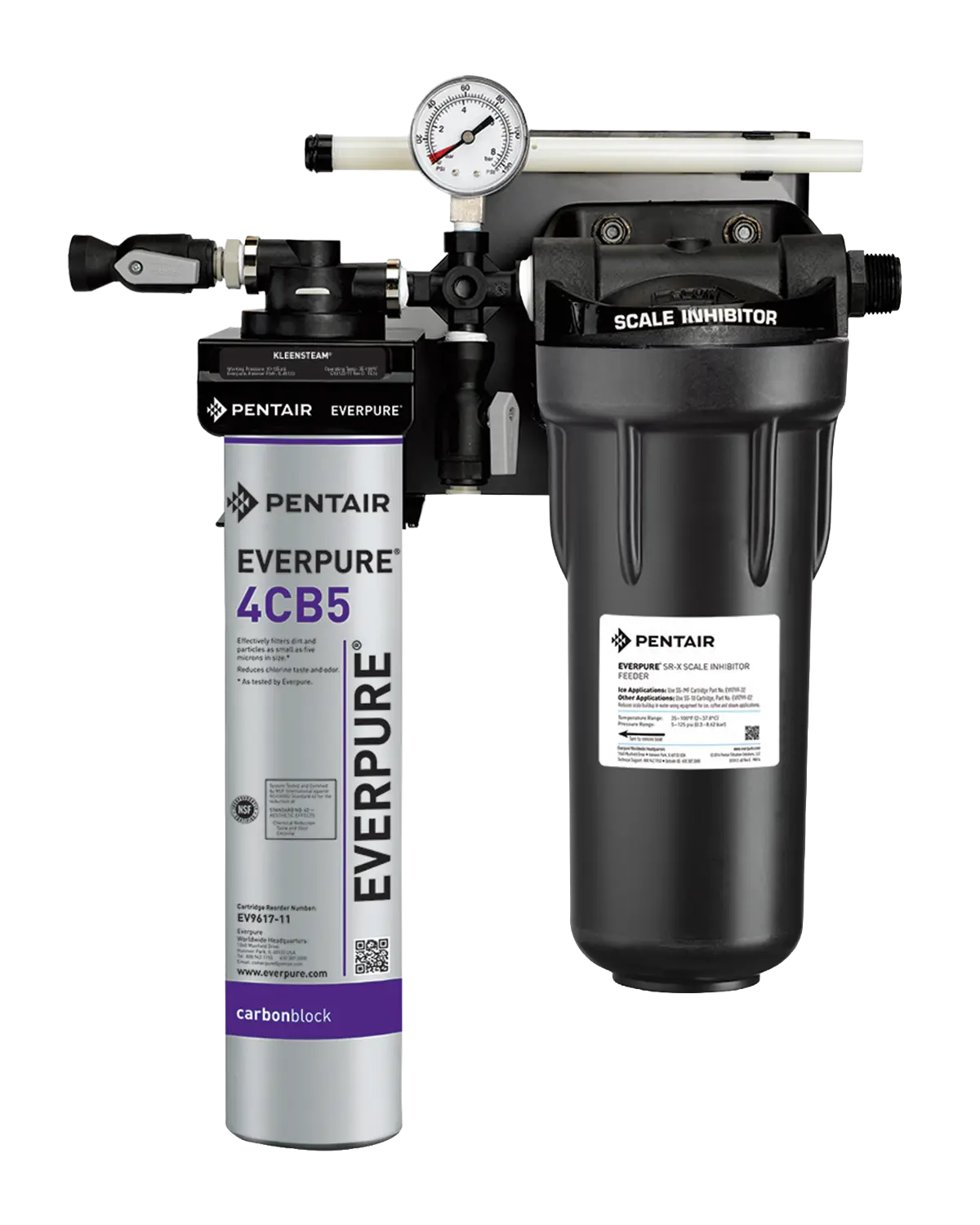
EV9797-50 / EV979750 combines a 4CB5 carbon cartridge with an SS-IMF HydroBlend cartridge and ScaleKleen-compatible deliming for applicable commercial steam equipment.
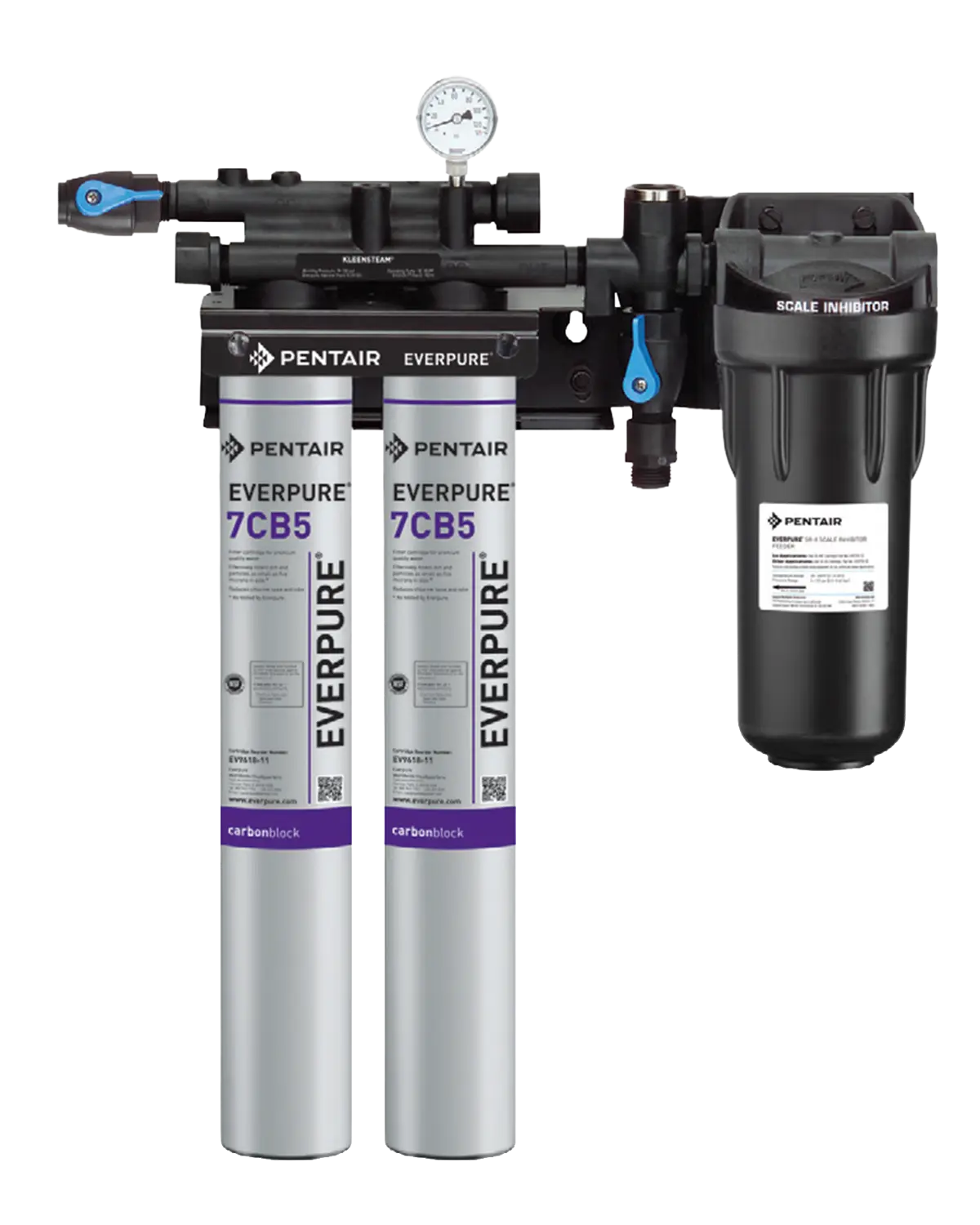
EV9797-22 / EV979722 uses two 7CB5 carbon cartridges with an SS-10 HydroBlend cartridge and ScaleKleen-compatible deliming. Fit depends on the exact oven or equipment bank and site requirements.
Certification is component-specific. The 4CB5 and 7CB5 cartridges carry applicable NSF/ANSI 42 certification for chlorine taste-and-odour reduction. The SS-IMF and SS-10 ScaleStick components conform to NSF/ANSI 42 material requirements only. The five-micron particulate statement is Pentair-tested, not an NSF reduction claim. No whole-system certification or manufacturing-origin claim is made here. Kleensteam CT must connect to the incoming cold-water boiler line only—not a hot-water, steam or condenser line. Kleensteam II Twin connects to boiler water only, not the condenser.
Use the equipment identity, boiler architecture, gas duty or electric rating where relevant—not a general kitchen-size label.
Compare maximum oven demand and simultaneous use with the verified 1.67 gpm CT or 5.0 gpm Twin limit.
Use expected water consumption, operating hours and number of connected units to plan capacity and cartridge duty.
Review hardness, alkalinity, TDS, chloride, chlorine, sediment and source variability against the exact OEM limits.
Confirm available pressure, 3/8-inch versus 3/4-inch FNPT connection needs and the correct feed-water line.
Allow full operating weight support, vertical mounting, cartridge clearance and safe access for replacement and deliming.
Final configuration should be checked against the exact combi-oven model and its manufacturer’s water requirements.
Kleensteam, softening, RO and deliming have different roles. More than one may be relevant, but none should be prescribed without the water report and exact OEM limits.
Appropriate to assess when source water is within the oven maker’s permitted range and particulate, chlorine and limescale management are relevant.
Ion exchange reduces calcium and magnesium hardness. Suitability depends on the equipment manufacturer’s permitted water chemistry.
RO reduces a broad range of dissolved ions and solids and may be appropriate when the equipment specification calls for tighter dissolved-mineral control.
Deliming removes mineral deposits already accumulated. It is planned maintenance and is not the same process as ongoing scale inhibition.
If source water falls outside the specific combi-oven manufacturer’s approved water-quality range, a different or additional treatment approach—including RO where appropriate—may be required.
Kleensteam is a point-of-use treatment assembly, but final fitment must follow the current Pentair instructions and the exact oven manufacturer’s utility requirements.
Designed for straightforward installation by a qualified plumber.
CT connects to the incoming cold-water boiler line only. Verify the corresponding Twin and oven connections before work begins.
Isolate the supply, replace the correct carbon and HydroBlend elements, flush the carbon stage for five minutes at full flow and complete a leak check.
Trained personnel should use ScaleKleen through the supported assembly only in accordance with approved service and equipment instructions.
Maintenance plan: Pentair calls for scheduled six-month replacement of the displayed systems’ carbon cartridges, or earlier when capacity is reached or pressure or flow becomes inadequate. Replace the applicable HydroBlend cartridge before its media is depleted. Site conditions and current product instructions govern the final schedule.
Allow correct pressure, inlet temperature, connections, vertical mounting, isolation, cartridge clearance, flushing, leak checks and ongoing access. Do not install CT on a hot-water, steam or condenser line.
Assessment priorities change with the equipment schedule, production model, source water, operating hours and service responsibilities. No scenario automatically determines CT or Twin.
Review multiple ovens, banquet peaks, engineering requirements, common utilities and planned maintenance ownership.
Match the exact oven, variable service demand, available pressure and back-of-house access.
Consider steam or proofing cycles, production duration, equipment design and the maker’s water limits.
Calculate combined flow, daily volume, simultaneous demand, source variability and service windows.
Review long production periods, peak demand, temporary load changes and practical service access.
Document equipment schedules, water reports, responsible teams and planned cartridge and deliming work.
Build repeatable assessment criteria while checking every site’s water, pressure and equipment configuration.
Keep equipment and decision records consistent without assuming different cities have equivalent source water.
Aquainwent helps customers select and buy products. A website enquiry does not book a site visit or installation.
Tell us the application, location and any product or equipment details you know.
Our team reviews the requirement against product specifications and any available water readings.
The team can discuss direct supply or connect you with an appropriate dealer and confirm the quotation.
Confirm product availability, delivery and any separately agreed installation or service responsibilities.
Trusted by leading hospitality & foodservice brands


Starbucks · McDonald’s · Marriott · Taj · Hilton · Oberoi · Fairmont · Westin · Barclays · KKR — and 100+ premium establishments across India.
Representative brands and hospitality groups where Everpure® by Pentair solutions supplied through Aquainwent or its dealers have been deployed. Brand names and trademarks are the property of their respective owners and are used for identification only. Logo presence does not imply endorsement or use of a specific Kleensteam configuration.
Aquainwent LLP is listed in Pentair Asia’s official Distributor/Dealer directory for India under Commercial Filtration & Foodservice.
Clear, evidence-disciplined answers for hotel teams, commercial kitchens, consultants and equipment partners.
A combi oven water filter treats the incoming feed water before it reaches the boiler or steam generator. In a correctly specified Kleensteam configuration, the relevant cartridges reduce particulate and chlorine taste and odour, while HydroBlend helps inhibit limescale formation. Exact functions depend on the installed components.
As water becomes steam, dissolved minerals remain behind and can form deposits during repeated heating and evaporation. The rate and type of buildup depend on source water, equipment design, operating demand and maintenance.
Scale inhibition helps keep hardness minerals from precipitating readily as limescale on heated surfaces and water pathways. It manages deposit formation; it does not remove hardness minerals from the water and cannot eliminate all future scale.
No. HydroBlend does not remove calcium and magnesium like ion-exchange softening and does not reduce dissolved solids like RO. Water chemistry must be compared with the exact oven manufacturer’s requirements to decide whether scale-control filtration is suitable.
Chlorine is a disinfectant that applicable carbon cartridges can reduce for taste and odour. Chloride is a dissolved ion with separate equipment-manufacturer limits. Carbon filtration does not remove chloride, so chloride concentration must be checked against the oven’s feed-water specification.
RO may be appropriate when source water falls outside the oven manufacturer’s permitted dissolved-mineral range or the specification calls for tighter control. It is not universally mandatory based on one generic hardness or chloride value; the decision should use the exact OEM limits, water analysis and application demand.
CT and Twin are not selected by kitchen size alone. Compare the exact oven model, boiler architecture, required service flow, daily demand, number of units, water chemistry, pressure, connections, installation space and service access. Final configuration must meet the equipment manufacturer’s requirements.
No. Scale-control treatment helps reduce limescale accumulation, but periodic deliming may still be required according to water quality, equipment operation and manufacturer maintenance guidance.
Everpure ScaleKleen is a deliming agent used to remove mineral deposits that have already accumulated. Where confirmed for the installed Kleensteam assembly, it can be introduced through the treatment assembly without boiler disassembly by trained personnel following approved service and equipment instructions.
For the displayed systems, Pentair calls for scheduled replacement of the 4CB5 or 7CB5 carbon cartridges every six months, or earlier when capacity is reached or pressure or flow becomes inadequate. Replace the applicable HydroBlend cartridge before its media is depleted and follow the current guidance for the installed configuration.
No. Fit depends on the oven make and model, OEM water limits, required flow, pressure, connections, source water, available space and service access. Hardness, alkalinity, TDS, chloride, chlorine and sediment should be reviewed where relevant.
The system is designed for straightforward installation by a qualified plumber. Final work must follow the applicable Pentair and oven-manufacturer instructions, including correct isolation, service clearance, flushing and leak checks. Kleensteam CT must connect to the incoming cold-water boiler line.
Ask about a listed product or share your requirement. Our team will review the enquiry and discuss direct supply or an appropriate dealer contact.