
Water-treatment variables
- Chlorine taste and odour
- Particulate and sediment
- Exact certified contaminant-reduction duties
- Source-water variation
- Service flow and rated capacity
- Feed-water suitability
Water is a major part of every post-mix drink. Aquainwent sizes Everpure by Pentair filtration around source-water conditions, dispenser and carbonator demand, service flow, total volume and any connected ice or coffee equipment.
Water treatment manages the water input. Syrup, Brix, CO₂, temperature, dispenser calibration, cleaning and ice also shape the final beverage.

Pentair Everpure’s fountain-drink sizing guide states that a fountain drink is approximately 83% water. Reducing a verified water-related issue such as chlorine taste and odour or particulate can therefore remove one source of unwanted variation.
That does not make filtration a recipe-control system. Final beverage quality still depends on concentrate, syrup-to-water ratio, CO₂ supply and pressure, carbonator condition, beverage temperature, dispenser calibration, cleaning and the ice served with the drink.
The 83% figure is approximate and applies to the fountain drink itself, not the ice.
A correct technical discussion separates what the water-treatment system can address from what the beverage programme and dispenser must control.
Water treatment addresses the water input. Brix and syrup-to-water ratio depend on dispenser calibration and the beverage programme.
The 4FC specification says it can help retain a drink’s carbonation. This does not mean filtration sets, increases or guarantees carbonation; the final level still depends on the beverage system.
These are selection inputs—not promises that one cartridge resolves every site condition.
Verified carbon or precoat filtration can reduce a water-related source of unwanted flavour variation.
Dirt, rust and pipe scale can load cartridges and affect small valves, pumps, tubing and orifices.
A system that cannot meet simultaneous valve or carbonator demand may create pressure and delivery problems.
Municipal, borewell, tanker, stored and centrally treated supplies can require different review and pretreatment.
Daily volume or cartridge capacity alone does not prove that peak service flow is adequate.
Fountain, ice and coffee may use separate systems or a correctly engineered combination configuration.
System selection begins with the actual beverage circuit and source water, not restaurant size or seat count.
Municipal, borewell, tanker, building storage or treated central supply.
Chlorine or chloramine where relevant, particulate, TDS, hardness and any known concern.
System brand, number of dispensers and the number and type of beverage valves.
Count and type, including whether they operate at the same time.
The treated-water rate required when several valves or carbonators draw together.
Estimate total treated-water use for capacity and replacement planning.
Confirm pressure under operating demand, not only static pressure.
Identify ice machines, coffee equipment and drinking-water points separately.
Space, mounting support, plumbing route, isolation and cartridge-service clearance.
These values answer different questions. None can substitute for the others.
The maximum treated-water rate the system can deliver under its rated conditions.
The total treated-water volume associated with the stated replacement rating under specified conditions.
The flow required when multiple valves or carbonators operate together at the busiest moment.
The dispenser, valve and equipment points the selected system must support through the actual piping arrangement.
Pentair’s fountain sizing guidance asks about carbonators and beverage usage. Final sizing must also reconcile equipment-manufacturer requirements and the installed hydraulic design.
The exact treatment train varies by product. Do not assume every function appears in every fountain system.
A separate prefilter in the High Flow CSR systems captures larger dirt before the primary cartridges. It is not part of every 4FC installation.
The featured systems document particles as small as 0.2 µm by mechanical means. This is not a public sterilisation claim.
Each featured product documents chlorine taste-and-odour reduction under its exact configuration and certification scope.
Pentair’s current High Flow CSR MC² family page documents chloramine-reduction prefiltration. This claim is specific to that documented family configuration and is not an NSF claim.
NSF/ANSI 53 mechanical cyst reduction applies to the exact listed systems. It is not bacteria killing, virus removal or general disinfection.
Triple-MC² and Triple-7FC include an SR-X stage for the applicable ice or coffee outlet. Fountain connects before that stage.
Three distinct configurations for different hydraulic and equipment duties. They are not a universal small-medium-large progression.
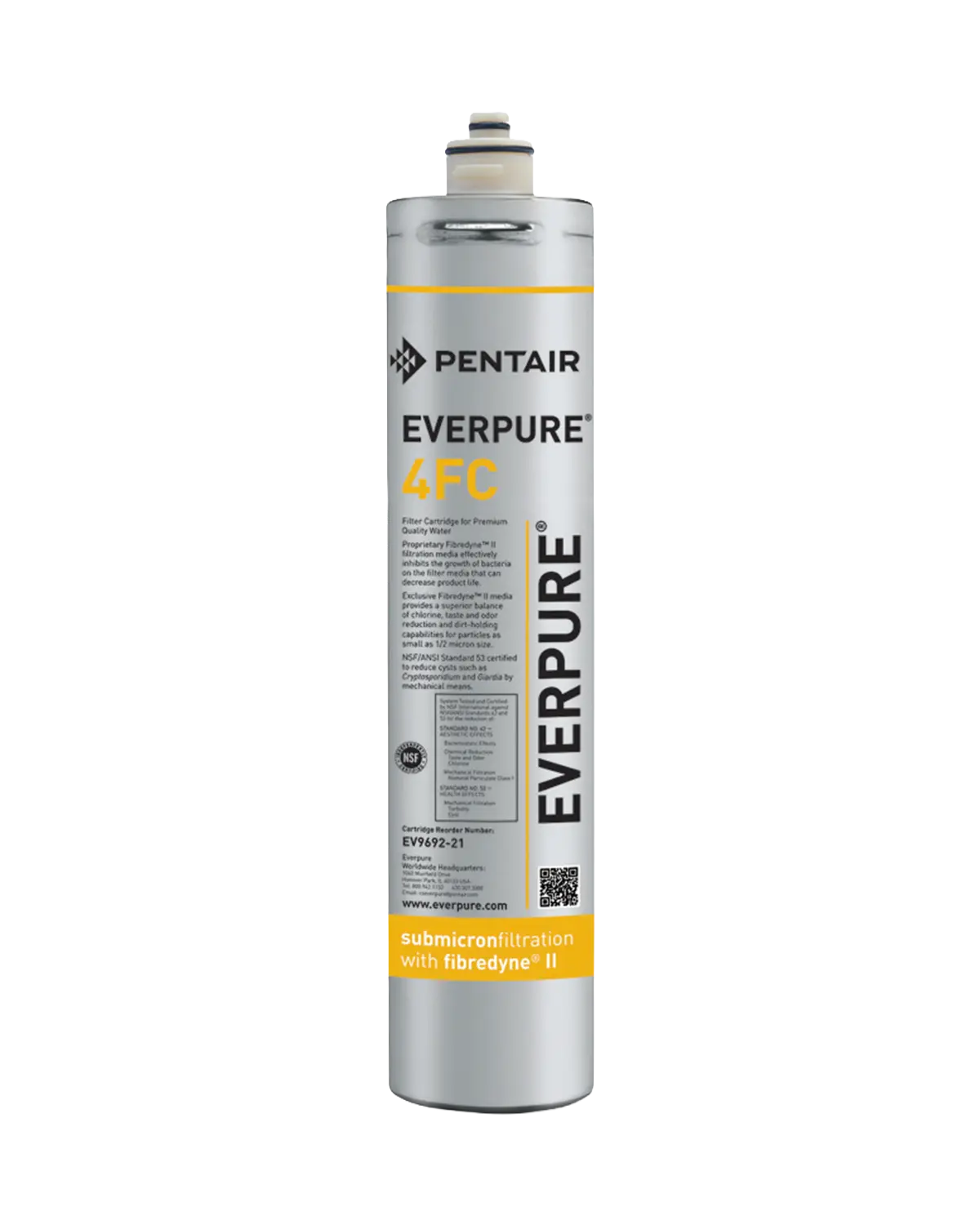
A replacement cartridge for compatible fountain and combination-system heads or manifolds where its verified flow, capacity and reduction scope fit the application.
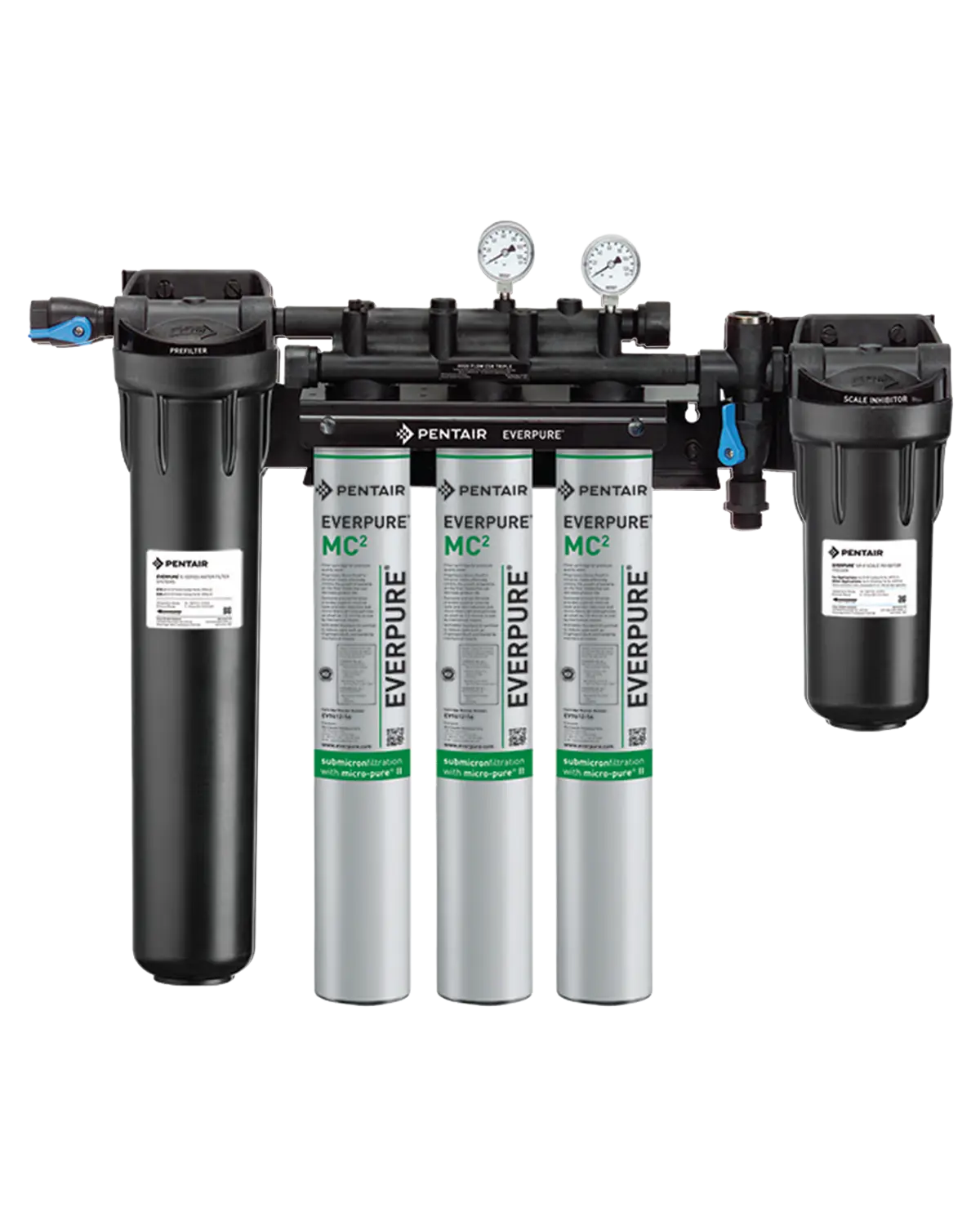
A manifold-based combination system for high-flow fountain, coffee and ice applications, with a 20-inch prefilter and a separate SR-X scale-control stage for the applicable ice or coffee branch.
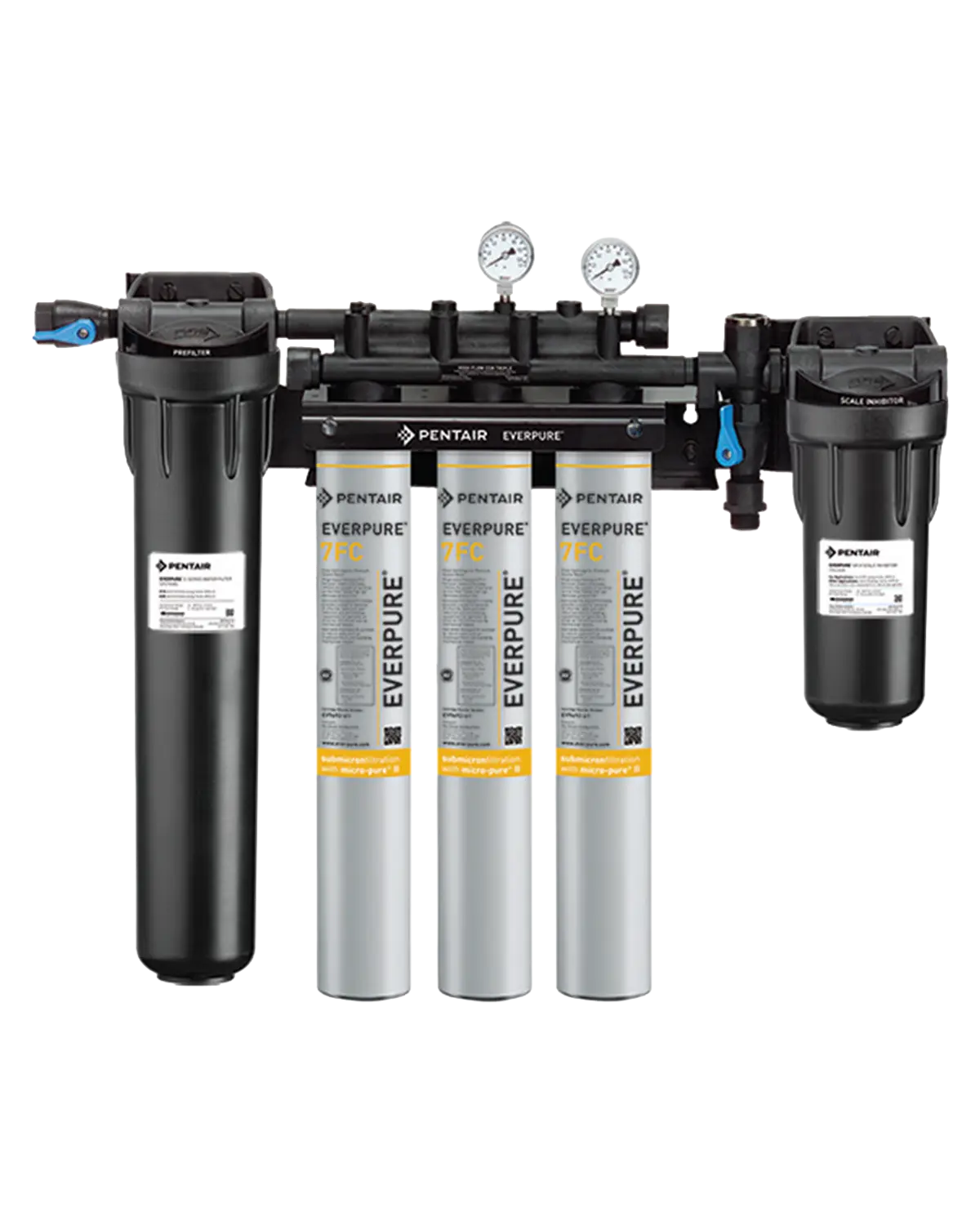
A high-flow combination system using three 7FC cartridges, integrated prefiltration and a separate SR-X scale-control stage for the applicable ice or coffee branch.
The 4FC image shows the EV9692-21 cartridge, not a complete installed system. Triple-MC² and Triple-7FC are complete manifold-based combination configurations with application-specific outlet arrangements. Chloramine language on this page is limited to Pentair’s current High Flow CSR MC² family documentation. All three products require final source-water, flow, pressure, equipment and installation review.
The answer depends on demand, equipment and treatment duty—not a generic restaurant-size label.
| Selection point | 4FC | Triple-MC² | Triple-7FC |
|---|---|---|---|
| Technical identity | Cartridge EV9692-21; compatible head/manifold required | Combination system EV9328-06 | Combination system EV9329-73 |
| Maximum service flow | 2.5 gpm / 9.5 LPM | 5 gpm / 18.9 LPM | 7.5 gpm / 28.4 LPM |
| Rated capacity | 15,000 gal / 56,781 L | 27,000 gal / 102,206 L | 75,000 gal / 283,906 L |
| Mechanical filtration | Particles as small as 0.2 µm | Particles as small as 0.2 µm | Particles as small as 0.2 µm |
| Main architecture | Quick-change cartridge in a compatible POU configuration | Triple MC² bank plus EC210 prefilter and SS-IMF stage | Triple 7FC bank plus EC210 prefilter and SS-XL stage |
| Combination role | Depends on compatible installed head/manifold | Fountain with defined ice/coffee branch after SR-X | Higher-flow fountain with defined ice/coffee branch after SR-X |
| Chloramine handling | No chloramine claim used | Current MC² family page documents chloramine-reduction prefiltration | No chloramine claim used |
| Certification | NSF/ANSI 42 & 53 for exact listed claims | NSF/ANSI 42 & 53 for exact listed claims | NSF/ANSI 42 & 53 for exact listed claims |
| Selection question | Does a compatible single-cartridge configuration meet peak flow and duty? | Does the 5 gpm combination architecture match the connected equipment? | Does the 7.5 gpm / 75,000-gallon configuration match measured demand and lifecycle needs? |
Maximum service flow and rated capacity are different measures. Neither is a guarantee of fit for the installed dispenser network.
Both can be valid. The complete hydraulic and treatment design determines the right architecture.
A separate POU configuration serves the fountain circuit. Select it from the exact dispenser and carbonator demand, source water, pressure and compatible head or manifold.
High Flow CSR can serve fountain plus compatible ice or coffee equipment through defined outlets. Fountain connects before the SR-X stage; the applicable ice or coffee branch connects after it.
Fountain and ice may use separate treatment systems or a correctly engineered combination system. Do not assume one filter automatically serves both. Review the Ice Machine Water Filtration Solution; treat guest or staff drinking-water points as a separate application through the Drinking Water Solution.
A different water concern requires a different treatment route. None should be prescribed from one number alone.
High particulate or turbidity may require separate source-side treatment before the fountain filtration stage.
Where verified chemistry falls outside the beverage-system requirement, broader dissolved-solids treatment may be assessed.
Explore Commercial ROHardness and scale risk are distinct from TDS and filtration. Softening is conditional and does not disinfect water.
Explore Water SofteningStandard fountain filtration is not general disinfection. Unsafe or unknown water requires appropriate assessment and treatment.
TDS boundary: Standard 4FC and High Flow CSR filtration does not reduce TDS. High TDS does not always mean RO, lower TDS is not always better and zero-TDS water is not automatically ideal for a beverage programme.
Installation and replacement must follow the exact system architecture, instructions and site conditions.
Designed for straightforward installation by a qualified plumber. High-flow manifolds require secure mounting, correct connection order, isolation and service clearance.
Quick-change cartridges can generally be replaced by trained site staff without specialist tools.
Isolate, replace the correct cartridges in the correct sequence, flush as instructed, restore service and perform a leak check.
| Configuration | Primary-cartridge guidance | Other stages |
|---|---|---|
| 4FC EV9692-21 | Use a regular six-month scheduled programme, or replace earlier at rated capacity or inadequate flow or pressure; always replace at least annually. | Follow the compatible head or manifold instructions. |
| Triple-MC² EV9328-06 | Regular six-month preventive-maintenance programme, or earlier at capacity or when pressure falls below 10 psi. | Change the EC210 when excessively dirty; change SS-IMF before HydroBlend media is depleted. |
| Triple-7FC EV9329-73 | Replace before rated capacity or when flow becomes inconveniently slow; at least annually; also respond if pressure falls below 10 psi. | Change the EC210 when excessively dirty; change SS-XL before HydroBlend media is depleted. |
Actual replacement planning must use the current exact product instructions, source-water quality, usage and observed flow or pressure condition. There is no universal interval for every fountain filter.
Each application still requires source-water and equipment-demand review.
Count valves and carbonators, then verify peak service flow during busy periods.
Separate fountain requirements from drinking-water, ice and coffee endpoints.
Review concentrated rush-period demand across multiple concession dispensers.
Confirm tenant plumbing, source responsibility, pressure and equipment layout.
Map restaurant, banquet, lounge, ice and coffee demand before combining treatment.
Size around highly concentrated simultaneous demand and service continuity planning.
Document source water, duty cycles, responsible staff and replacement process.
Use a governed selection standard while retaining water and equipment exceptions by site.
Aquainwent helps customers select and buy products. A website enquiry does not book a site visit or installation.
Tell us the application, location and any product or equipment details you know.
Our team reviews the requirement against product specifications and any available water readings.
The team can discuss direct supply or connect you with an appropriate dealer and confirm the quotation.
Confirm product availability, delivery and any separately agreed installation or service responsibilities.
Trusted by leading hospitality & foodservice brands


Starbucks · McDonald’s · Marriott · Taj · Hilton · Oberoi · Fairmont · Westin · Barclays · KKR — and 100+ premium establishments across India.
Representative brands and hospitality groups where Everpure® by Pentair solutions supplied through Aquainwent or its dealers have been deployed. Brand names and trademarks are the property of their respective owners and are used for identification only. Logo presence does not imply endorsement or use of a specific fountain-beverage product or configuration.
Aquainwent LLP is listed in Pentair Asia’s official Distributor/Dealer directory for India under Commercial Filtration & Foodservice.
Evidence-disciplined answers for operators, engineers, procurement teams, consultants and project partners.
A fountain beverage water filter is a commercial point-of-use system selected for the water feeding post-mix dispensers. Depending on the exact product, it can reduce chlorine taste and odour, particulate and specified certified contaminants while supplying the required service flow.
Pentair Everpure sizing guidance states that a fountain drink is approximately 83% water, excluding ice. Water treatment therefore matters, but final beverage quality also depends on syrup, Brix, carbonation, temperature, calibration, cleaning and ice.
Chlorine and chloramine claims are product-specific. The three featured products document chlorine taste-and-odour reduction. Pentair’s current High Flow CSR MC² family documentation also identifies prefiltration media for chloramine and chlorine taste-and-odour reduction; this additional claim is limited to that documented family configuration.
No. Water treatment addresses the water input. Brix and syrup-to-water ratio depend on dispenser calibration and the beverage programme, not the water filter.
No. Carbonation depends on CO₂ supply and pressure, carbonator performance, water temperature, dispenser design and calibration. Pentair states that the 4FC can help retain a drink’s carbonation; this is not a claim that filtration sets, increases or guarantees the carbonation level.
Service flow is the maximum treated-water rate under rated conditions. Capacity is the total treated-water volume associated with the replacement rating. Peak simultaneous demand is the flow required when several valves or carbonators operate together. High capacity does not automatically mean adequate peak service flow.
Sizing should review the dispenser arrangement, number of beverage valves, number and type of carbonators, peak simultaneous demand, daily volume, water pressure, source-water condition and any ice or coffee equipment served. Restaurant size or seat count alone is not enough.
It may, when an exact combination system is engineered for both duties. High Flow CSR systems provide defined fountain and ice or coffee connection arrangements, including a scale-control stage on the applicable ice or coffee branch. Do not assume one filter automatically serves both applications.
Everpure 4FC EV9692-21 is a replaceable cartridge for compatible fountain and combination-system heads or manifolds. It provides a maximum 2.5 gpm or 9.5 LPM service flow and a 15,000-gallon or 56,781-litre rated capacity.
A High Flow CSR system is a manifold-based combination configuration with primary filtration, prefiltration and a separate scale-control stage for the applicable ice or coffee branch. Triple-MC² EV9328-06 and Triple-7FC EV9329-73 have different media, flow, capacity and replacement guidance and are not simply medium and large versions of one filter.
RO may be assessed when verified source-water chemistry falls outside the beverage-system or operator requirement and broader dissolved-solids treatment is needed. High TDS does not automatically prescribe RO, and lower or zero TDS is not automatically better.
No. Standard carbon, precoat and particulate filtration should not be presented as TDS reduction. TDS is one water-quality parameter; exact product reduction duties, flow and application requirements still control selection.
Follow the exact system instructions. The 4FC specification recommends a regular six-month scheduled programme, or earlier at capacity or inadequate flow or pressure, and always at least annually. Triple-MC² calls for a regular six-month preventive-maintenance programme plus capacity and pressure triggers. Triple-7FC uses flow, capacity and pressure triggers with at-least-annual guidance. Prefilters and scale-control cartridges have separate condition-based guidance.
Quick-change cartridges can generally be replaced by trained site staff without specialist tools. The applicable isolation, cartridge sequence, flushing and leak-check procedure must still be followed, and the high-flow manifold installation itself requires a qualified plumber or technician.
Ask about a listed product or share your requirement. Our team will review the enquiry and discuss direct supply or an appropriate dealer contact.